

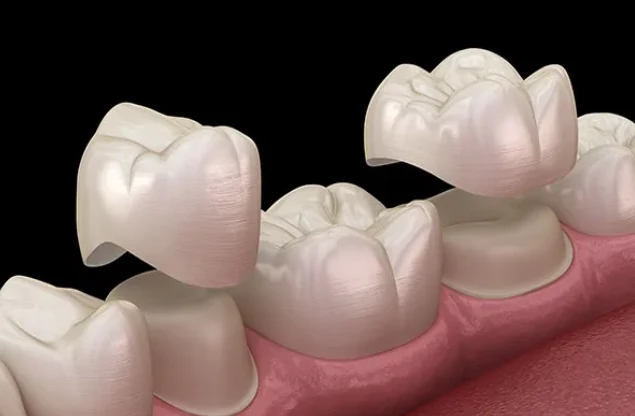
If your crown fell out without pain, contact your dentist promptly to arrange an evaluation, even if the exposed tooth feels normal. The crown may have loosened because of weakened cement, decay, or damage underneath. A dentist needs to examine the tooth and determine whether the crown can be reattached or requires replacement.
A painless lost crown is not always a medical emergency, but it should not be ignored. Keep the crown in a safe container, avoid chewing on the affected tooth, and ask your dental office how soon you should be seen.
Why Do Dental Crowns Come Loose or Fall Out?
Dental crowns are custom-made restorations that cover teeth weakened by decay, fractures, or extensive dental work.
They help restore the tooth’s shape and function while protecting the remaining structure.
However, crowns are not permanently attached under every circumstance. Their retention can change over time because of wear, damage, or changes in the supporting tooth.
Dental Cement Can Lose Its Hold
Dental cement helps secure a crown to the prepared tooth.
Over time, the bond may weaken because of normal function, material deterioration, or other factors.
Sometimes, a crown separates while the underlying tooth remains relatively unchanged.
In these situations, the dentist may be able to clean and reattach the existing crown.
However, weakened cement is only one possible explanation. A professional must confirm why the restoration became loose before recommending recementation.
Decay Beneath the Crown
A crown covers the visible portion of a prepared tooth, but the tooth beneath it can still develop decay.
Bacteria may enter through a compromised margin where the crown meets the tooth.
As decay progresses, the supporting tooth structure may change, affecting the crown’s fit and retention.
A crown that falls out because of underlying decay may require additional treatment before another restoration can be placed.
Importantly, tooth decay does not always cause noticeable pain.
Damage to the Supporting Tooth
Dental crowns are sometimes placed on teeth that have already experienced considerable damage.
A fracture or loss of supporting tooth structure may cause a crown to become loose.
Grinding, clenching, and excessive biting forces can also contribute to problems with restorations.
The American Dental Association (ADA) explains that crowns are used to strengthen or restore teeth that are weakened, broken, or extensively filled.
When a crown comes off, the remaining tooth should be evaluated before deciding how to restore it.
Temporary Versus Permanent Crowns: Does the Timing Change?
A lost temporary crown and a lost permanent crown require dental attention, but their purposes and attachment methods differ.
Understanding which restoration came off can help the dental office determine the appropriate next step.
What if a Temporary Crown Falls Out?
Temporary crowns protect prepared teeth while permanent restorations are being fabricated.
They are generally attached with provisional cement designed to allow removal when the final crown is ready.
Because this attachment is intentionally less permanent, temporary crowns can become dislodged.
Patients sometimes ask, “My temporary crown fell out, but it doesn’t hurt. Can I leave it off?”
The answer is that the dentist should still be contacted promptly.
Without the temporary crown, the prepared tooth may become exposed to temperature changes, food, and chewing forces.
The surrounding teeth or gum tissues may also change in ways that affect the final restoration’s fit.
A dentist can determine whether the temporary crown should be reattached, replaced, or managed differently based on the scheduled treatment.
What if a Permanent Crown Falls Out?
Permanent crowns are intended to provide longer-term protection and function.
If a permanent crown becomes detached, the dentist must determine whether the restoration itself remains suitable.
Possible findings include weakened cement, decay, damaged tooth structure, or changes affecting the crown’s fit.
Even an intact crown may not be appropriate for recementation if the underlying tooth has changed.
Do not assume that a permanent crown can simply be glued back into position.
How Quickly Should You Call?
Contact your dental office as soon as you notice the missing crown, preferably the same day.
If the crown comes off outside regular office hours and you have no pain, swelling, or other concerning symptoms, call when the office next opens or follow its after-hours instructions.
The dental team can determine whether you need an urgent appointment or the next suitable restorative visit.
Avoid waiting several weeks simply because the tooth does not hurt.
Why Lack of Pain Does Not Rule Out Dental Damage
Pain is an important symptom, but it does not reliably establish whether a tooth is healthy.
A tooth can have an exposed surface, weakened structure, or decay without producing immediate discomfort.
A Previously Root Canal-Treated Tooth May Not Hurt
Some crowned teeth have previously received root canal treatment.
During that procedure, the affected pulp tissue inside the tooth is removed.
Because the tooth no longer has the same internal nerve response, certain problems may develop without the typical sensitivity associated with a vital tooth.
However, root canal-treated teeth can still develop infections or experience other complications.
The absence of pain does not confirm that the tooth or surrounding tissues are healthy.
Exposed Tooth Structure Can Be Vulnerable
Before a crown is placed, the dentist prepares the natural tooth to accommodate the restoration.
When the crown comes off, portions of that prepared tooth may become exposed.
Depending on the amount of remaining enamel and dentin, the tooth may be more vulnerable to irritation or damage from chewing.
It may also be harder to keep the exposed surfaces clean.
A tooth that feels normal immediately after losing a crown may become sensitive later.
Food and Bacteria Can Collect Around the Tooth
Without the crown in place, the remaining tooth may have irregular contours or areas where food collects.
These conditions can make cleaning more difficult.
Plaque and food accumulation may contribute to further dental problems when left unaddressed.
The dentist should evaluate the exposed tooth and explain how to protect it until treatment is completed.
A Painless Crown Loss Still Needs an Examination
Consider a patient in Cleburne whose back-tooth crown comes off while eating.
There is no bleeding, swelling, or sensitivity.
Although the situation may not require hospital emergency treatment, the patient cannot determine whether the supporting tooth is intact simply by looking at it.
An examination can establish whether recementation is appropriate or whether another treatment is needed.
What Should You Tell the Dental Office?
Providing accurate information when you call helps the dental team assess the situation and arrange appropriate care.
You do not need to know exactly why the crown fell out.
The most useful details involve the restoration, the tooth, and any symptoms you have noticed.
Information to Share When Calling
Tell the office:
- When the crown fell out: Include whether it happened today or several days ago.
- Which tooth is affected: Identify whether it is a front or back tooth.
- Whether the crown is temporary or permanent: Explain if you recently had crown preparation.
- Whether you still have the crown: Mention if it appears intact or damaged.
- Any symptoms: Report pain, sensitivity, swelling, bleeding, or a sharp exposed edge.
- How it happened: Describe whether it came off while eating or after an injury.
Also mention whether the tooth had previous root canal treatment, if known.
The team may ask additional questions before determining the appropriate appointment.
What Should You Do With the Crown?
If you can retrieve the crown safely, keep it and bring it to your dental appointment.
Place it in a clean, secure container to prevent loss or damage.
Do not attempt to scrape away cement or modify the crown.
The dentist will examine the restoration to determine whether it remains usable.
If the crown has broken into pieces, save the pieces when possible and explain what happened.
Can You Eat While the Crown Is Missing?
You may be able to eat while waiting for dental care, but avoid chewing on the affected tooth.
Choose softer foods that do not require substantial biting pressure.
Avoid hard, sticky, or particularly chewy foods that could damage the exposed tooth.
Very hot or cold foods may also cause sensitivity.
NHS guidance for lost crowns recommends maintaining oral hygiene and avoiding hard foods on the affected tooth while awaiting assessment.
Continue brushing gently with fluoride toothpaste.
Should You Put the Crown Back Yourself?
Do not use superglue, household adhesive, or another non-dental product to attach a crown.
These materials are not designed for oral restorative treatment and can cause complications.
Although some temporary dental cement products are available, they are not suitable for every situation.
An improperly positioned crown may affect your bite, become dislodged again, or create a swallowing or choking risk.
Contact your dentist for individualized instructions before attempting temporary reattachment.
Assessment and Recementation Versus Replacement
Whether the original crown can be saved depends on the condition of both the restoration and the supporting tooth.
A dental examination helps distinguish a straightforward loss of retention from a more complicated restorative problem.
What Happens During the Examination?
The dentist may begin by asking how the crown became detached and whether you have experienced any symptoms.
The evaluation generally includes examining the exposed tooth, surrounding gums, and the crown itself.
Dental imaging may be recommended when necessary to assess decay, fractures, or other concerns not visible during the examination.
The dentist may also evaluate how the crown fits and how the affected tooth contacts opposing teeth.
These findings help determine the appropriate treatment.
When Can the Original Crown Be Recemented?
Recementation may be possible when the crown remains intact, fits properly, and the supporting tooth is healthy enough to retain it.
The dentist must also determine why the original attachment failed.
If the crown is suitable, the tooth and restoration can be prepared for professional recementation.
However, reusing an existing crown is not guaranteed.
A crown that appears undamaged outside the mouth may still have fit problems that become apparent during examination.
When Is Replacement More Appropriate?
A new crown may be recommended when the original restoration is fractured, worn, poorly fitting, or otherwise unsuitable.
Replacement may also be needed when decay or damage has changed the prepared tooth.
Some teeth require additional restorative treatment before a new crown can be placed.
For example, the dentist may need to address decay and evaluate whether sufficient healthy tooth structure remains.
The treatment plan depends on the findings rather than the patient’s pain level.
What if the Tooth Cannot Support Another Crown?
In some situations, the remaining tooth structure may be too compromised for predictable restoration.
The dentist may discuss additional procedures or other treatment options based on the extent of damage.
Extraction is not automatically necessary simply because a crown falls out.
The objective is to assess whether the natural tooth can be preserved appropriately.
At Benage Dental Care of Cleburne, we provide restorative dentistry, including dental crowns. Our team can evaluate the affected tooth and explain available treatment options.
For more information about our restorative services, visit our general dentistry page.
Urgent Symptoms and Arranging Care
A painless lost crown generally calls for prompt dental advice rather than automatically requiring a hospital emergency visit.
However, certain symptoms indicate that more immediate attention is necessary.
When Should You Seek Urgent Dental Care?
Contact a dentist urgently if the lost crown is accompanied by:
- Severe or worsening tooth pain
- Significant swelling around the gums or jaw
- A visibly broken or fractured tooth
- Persistent bleeding
- Signs of infection, such as pus or fever
- Trauma affecting the tooth or surrounding tissues
- Difficulty biting because of a damaged or unstable tooth
Cleveland Clinic recommends arranging dental care promptly when a crown or other restoration is lost or broken.
If you develop difficulty breathing, difficulty swallowing, or rapidly spreading facial or neck swelling, seek emergency medical care immediately.
If the crown may have been inhaled and you develop coughing or breathing symptoms, obtain urgent medical evaluation.
What if There Is No Pain or Swelling?
If the crown is missing but the tooth feels normal, avoid treating that as proof that everything is fine.
Contact the dental office promptly and explain that the crown has come off without discomfort.
The team can determine the appropriate appointment timing.
Do not postpone evaluation until pain develops.
Schedule a Crown Assessment in Cleburne
At Benage Dental Care of Cleburne, we provide restorative and emergency dental services for patients in Cleburne and throughout Johnson County.
Drs. Mark and AnneMarie Benage can evaluate the affected tooth, examine the restoration, and discuss suitable treatment options.
Our emergency dentistry services include assessment of lost or broken crowns.
Appointment availability and treatment timing depend on the circumstances and the office schedule.
FAQs
Is a Painless Lost Crown Urgent?
A painless lost crown may not require emergency medical treatment, but it should be assessed promptly by a dentist. The supporting tooth may be exposed or damaged even without discomfort. Contact your dental office as soon as possible for appointment instructions.
Can a Crown Be Put Back On?
Sometimes. A dentist may be able to recement an intact crown when it still fits correctly and the supporting tooth remains suitable. If decay, fractures, or poor fit are present, repair or replacement may be necessary.
What if a Temporary Crown Falls Out?
Contact the dentist who prepared the tooth. A temporary crown protects the tooth while the permanent restoration is being made. Even without pain, the exposed tooth may need protection, and changes in the surrounding area can affect the final crown’s fit.
Can I Eat While a Crown Is Missing?
You can generally eat carefully, but avoid chewing on the affected tooth. Choose softer foods and avoid hard or sticky items. Maintain gentle oral hygiene and follow the dental office’s instructions until the tooth is evaluated.
Why Does My Tooth Not Hurt After Losing a Crown?
The tooth may not currently have exposed sensitive areas, or it may have undergone root canal treatment. However, the absence of pain does not rule out decay, fractures, or other problems. Only a dental examination can establish the condition of the tooth.
Can I Wait Until My Next Routine Dental Cleaning?
It is better to contact your dentist when the crown comes off instead of waiting for an unrelated future appointment. The office can determine how soon you should be evaluated based on your symptoms, tooth condition, and restoration type.
Have Your Lost Crown Checked at Benage Dental Care
A crown that falls out without pain still deserves dental attention. Getting the tooth evaluated can help determine whether the original crown can be reused or whether another restoration is necessary.
At Benage Dental Care of Cleburne, we provide dental crown evaluations and restorative treatment for patients in Cleburne, TX, and surrounding Johnson County communities.
If your crown has come off, keep it in a safe container, avoid chewing on the exposed tooth, and contact our office for instructions.
Call Benage Dental Care at (817) 641-6261 to arrange an evaluation at 302 North Ridgeway Drive, Cleburne, TX 76033. Our team can discuss your symptoms and help you determine the appropriate next step.